Tlazolteotl: the Aztec goddess who ate filth and forgave sins

Chaos Society
Acervo de estudo · magia, ocultismo e esoterismo
The goddess of filth
The name Tlazolteotl comes from tlazolli, "rubbish, dirt, leftovers", and teotl, "divinity". For the Aztecs, filth was not only physical: it was everything that fell outside order, above all sexual excess and transgression. Tlazolteotl was the goddess who provoked those excesses and also the one who gathered them up. Hence her title Tlaelcuani, "she who eats filth".
She is a figure who puzzles modern readers. The same goddess presides over desire, adultery, childbirth, midwives, steam baths and healing. What ties it all together is the idea of purification: whatever soils needs someone to clean it.
The confession described by Sahagún
The Franciscan friar Bernardino de Sahagún, who in the 16th century compiled with Indigenous informants the encyclopedia known as the Florentine Codex, describes a confession before the goddess. A person, usually already mature, sought out a priest of Tlazolteotl, who consulted the calendar to choose a favourable day. Before the fire and the copal incense, they confessed their faults, especially sexual ones. The priest imposed a penance, such as fasting or offerings, and the person left purified.
According to Sahagún, this could only be done once in a lifetime, and it also served as protection before the law: whoever confessed was not punished for what they had confessed. The friar naturally compared the rite with Catholic confession, and scholars debate how far that comparison shaped his description.
Childbirth, midwives and the temazcal
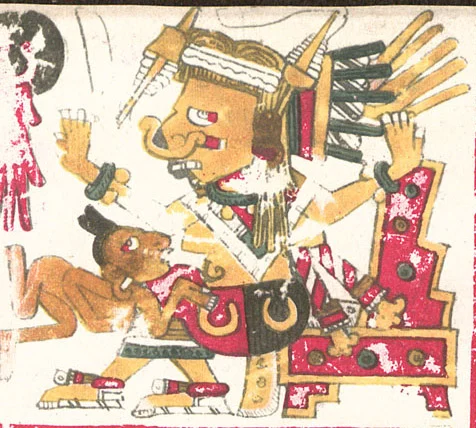
Tlazolteotl was also patron of childbirth. In the Codex Borbonicus, an Aztec ritual manuscript, she appears squatting as she gives birth, with a small figure emerging from her body. Midwives called on her, and the temazcal, the steam bath used after childbirth and for healing, was her space. The link between sex, birth and cleansing is direct: birth is the moment the body opens and needs care.
Huastec origin and the four sisters
Many scholars note that the cult of Tlazolteotl came from the Huastec region, on the Gulf coast of Mexico, and was absorbed by the Aztecs. Her image often wears unspun cotton in the headdress and ears, a Huastec trait, and a mouth painted black. The sources also speak of four aspects or sisters, the Ixcuiname, linked to different ages of life.
She took part in the great autumn festival of Ochpaniztli, "sweeping", dedicated to the goddesses of earth and fertility, when everything from houses to temples was swept and cleaned.
Modern readings
The art historian Cecelia Klein and other scholars have shown how Tlazolteotl reveals an Aztec view of the body and sexuality very different from the European one: desire is not sin in itself, but a force that can throw things out of balance and needs to be rebalanced. In contemporary spirituality, especially in Mexico, she has returned as a goddess of healing and female sexuality.
- Filth: disorder, excess and transgression.
- Purification: confession, penance, the temazcal.
- Childbirth: patron of midwives and mothers.
- Origin: probably Huastec, absorbed by the Aztecs.
For other deities from the same world, see the article on Xochiquetzal, and for cleansing practices, the guide to cleansing rituals.
Sources and further reading
- Bernardino de Sahagún, General History of the Things of New Spain (Florentine Codex), books I and VI (16th century)
- Codex Borbonicus
- Diego Durán, History of the Indies of New Spain
- Elizabeth H. Boone, Cycles of Time and Meaning in the Mexican Books of Fate (2007)
- Cecelia F. Klein, studies on Tlazolteotl and Aztec sexuality
Reviewed by the Chaos Society editorial team in November 2026.
Frequently asked questions
Who was Tlazolteotl?
An Aztec goddess linked to filth (tlazolli), sexuality, childbirth, midwives and purification. She was called Tlaelcuani, "eater of filth", because she received confessed sins and consumed them.
What was confession before Tlazolteotl like?
According to Friar Bernardino de Sahagún, a person could confess their excesses, especially sexual ones, once in a lifetime, before a priest of the goddess, on a date chosen by the calendar. They received a penance and were made clean.
Was Tlazolteotl an evil goddess?
No. Filth, for the Aztecs, was a disorder that had to be gathered up. Tlazolteotl provoked desire and also cleansed it. She is a goddess of transgression and of healing at the same time.