Metatron: the angel who was Enoch and the problem of the "two powers"

Chaos Society
Acervo de estudo · magia, ocultismo e esoterismo
The highest angel, and the most troublesome
Metatron is one of the most powerful angels in Jewish tradition: prince of the Presence, heavenly scribe, keeper of secrets. He is also one of the most awkward for theology, because in some texts he comes so close to God that he looks like a second power in heaven. That tension is the key to understanding his story.
Enoch, the man who did not die
Genesis says little about Enoch, the seventh patriarch after Adam: "And Enoch walked with God: and he was not; for God took him" (Genesis 5:24). That disappearance without death fed centuries of speculation. The First Book of Enoch, written before Christ, made him a visionary who travels through the heavens. The Third Book of Enoch, also called Sefer Hekhalot, written in Hebrew sometime between the 5th and 9th centuries, went further: Enoch is transformed into an angel, his body becomes fire, and he receives 72 wings, a throne and the name Metatron.
In the same text he is called "the lesser YHWH" (YHWH ha-qatan), because, the book says, the name of God is in him, as in the angel of Exodus 23:21.
The "two powers" and the flogging
The Talmud, in Hagigah 15a, tells the story of four sages who "entered the Pardes", the orchard of mysteries. One of them, Elisha ben Abuyah, saw Metatron seated in heaven, recording the merits of Israel. Since no one sits on high but God, Elisha concluded: "Perhaps there are two powers". The remark made him a heretic, and the Talmud says Metatron was punished with sixty lashes of fire to show he was not a second god.
The scene reveals the problem. Metatron was too important, and the rabbis had to demote him explicitly. Gershom Scholem and, later, Andrei Orlov showed how this tension runs through the whole mystical literature of the heavenly palaces, the hekhalot.
Other passages are calmer: in Avodah Zarah 3b, Metatron teaches the children who died before they could learn the Torah.
Where the name comes from
Nobody knows. Suggestions include the Greek meta thronos, "the one beside the throne", and the Latin metator, "the one who measures or guides the way". None is agreed. The Hebrew spelling varies, and some mystics calculated the numerical value of the name to link it with Shaddai.
Metatron in Western Kabbalah
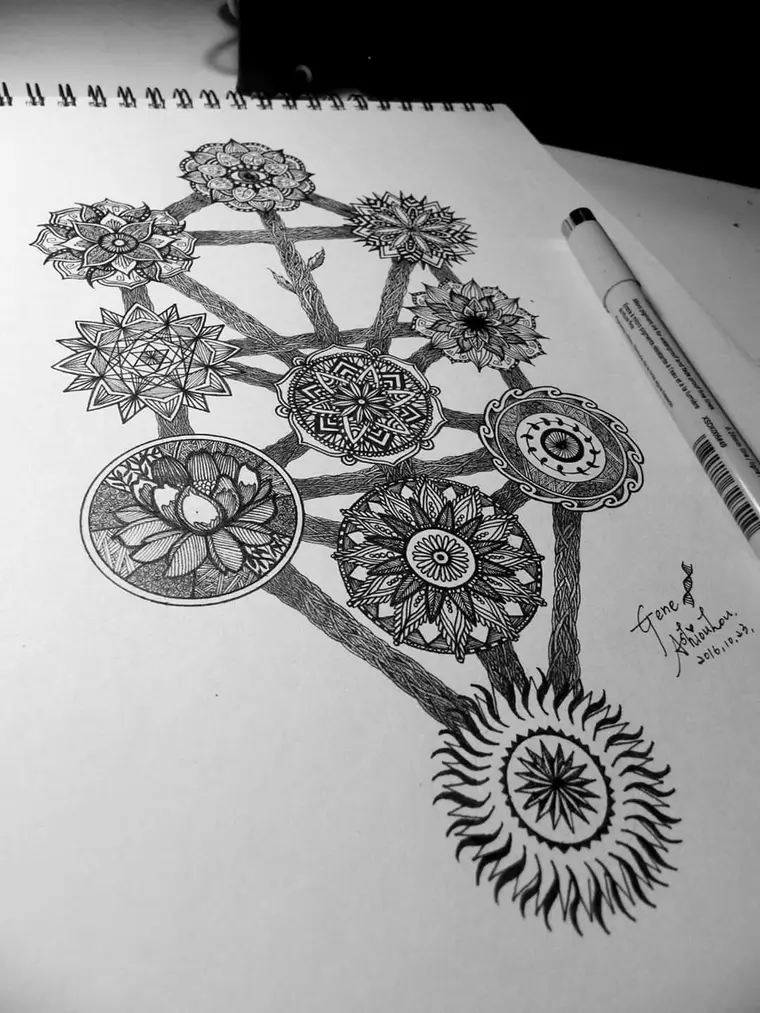
Modern ceremonial magic, from the Golden Dawn onwards, placed Metatron as the archangel of Kether, the first sephirah of the Tree of Life, and linked him with the beginning of all things. In many contemporary practices he is called on for protection, spiritual guidance and study, in keeping with his role as scribe and teacher.
"Metatron's cube", so popular in jewellery and tattoos, is another story. It is a modern sacred geometry figure that joins the centres of the 13 circles of the so-called Fruit of Life, popularised in the late 20th century. It does not appear in ancient Jewish sources and has no documented connection with the angel beyond the name.
Going further
See how the angels are organised in the catalogue of the 72 angels of the Shem ha-Mephorash and in the 72 names, and read the guide to the Kabbalah.
Sources and further reading
- Genesis 5:24
- Babylonian Talmud, Hagigah 15a, Sanhedrin 38b, Avodah Zarah 3b
- 3 Enoch (Sefer Hekhalot)
- Gershom Scholem, Major Trends in Jewish Mysticism (1941)
- Philip Alexander, translation and introduction of 3 Enoch, in The Old Testament Pseudepigrapha (1983)
- Andrei Orlov, The Enoch-Metatron Tradition (2005)
Reviewed by the Chaos Society editorial team in November 2026.
Frequently asked questions
Who is Metatron?
An angel of the very highest rank in Jewish tradition, called the prince of the Presence and the heavenly scribe. In the Third Book of Enoch he is the patriarch Enoch, taken up to heaven and transformed into an angel.
Does Metatron appear in the Bible?
No. The Bible only says that Enoch walked with God and was no more, because God took him (Genesis 5:24). Metatron appears in the Talmud and in later Jewish mystical literature.
Where does Metatron's cube come from?
It is a modern sacred geometry figure, popularised in the late 20th century, that joins the centres of the 13 circles of the so-called Fruit of Life. It does not appear in ancient Jewish sources.