Fraternitas Saturni: the German order of Saturn, Thelema and love without pity

Chaos Society
Acervo de estudo · magia, ocultismo e esoterismo
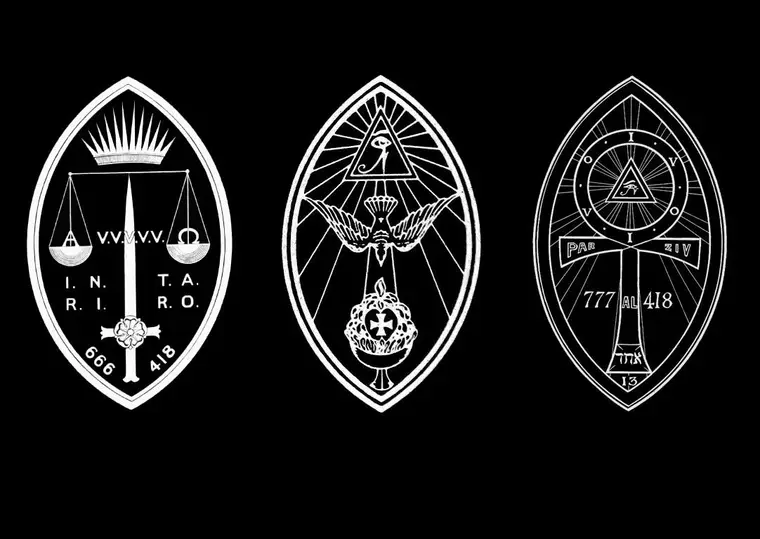
The order of Saturn
The Fraternitas Saturni, the "Brotherhood of Saturn", is one of the most influential magical orders of 20th-century Germany and one of the least known outside it. Its symbolic centre is Saturn, the planet of boundaries, time and discipline, which the order identifies with Lucifer, the light-bearer. Almost everything known about it in the English-speaking world comes from Stephen Flowers' Fire & Ice (1990), which published and commented on internal documents.
The Weida meeting
The story begins in 1925 in the town of Weida, in Thuringia. Heinrich Tränker, head of an occult group called Pansophia, hosted Aleister Crowley for a conference. Crowley wanted to be recognised as the world teacher announced in The Book of the Law. The group split: some accepted Crowley, others rejected him.
Among those present was Eugen Grosche, a Berlin bookseller. He accepted the Law of Thelema but not Crowley's personal authority. Over the following years he gathered his own followers and, in the late 1920s, founded the Fraternitas Saturni under the magical name Gregor A. Gregorius.
Thelema with love without pity
The order adopted the formulas of Thelema, "Do what thou wilt shall be the whole of the Law" and "Love is the law, love under will", with an addition of its own: mitleidlose Liebe, love without pity. The point is not cruelty. It is a rejection of the sentimental compassion that, in the order's view, weakens the will: a love that serves growth, even when it is hard. It is a Saturnian ethic of rigour and limits.
Saturn, the Demiurge and Lucifer
In the doctrine of the Fraternitas Saturni, the so-called Saturnian gnosis, Saturn is the guardian of the threshold between the material world and what lies beyond. He is at once the Demiurge who imprisons spirit in matter and the Lucifer who offers a way out through consciousness. The initiate must face Saturn, not flee from him, in order to go further.
The order also worked with astrology, sex magic, mirror magic and the idea of a "new age" of Aquarius, blending Thelema, Gnosticism and the German occultism of the interwar years. It had a structure of 33 degrees and strict internal discipline.
Nazism, exile and the post-war years
Like many occult societies, the Fraternitas Saturni was banned by the Nazi regime in the 1930s. Grosche spent part of the period outside Germany, and his books and papers were confiscated. After the war the order reorganised in West Germany, resumed publishing and, in the 1950s and 1960s, ran the journal Blätter für angewandte okkulte Lebenskunst, "pages for the art of applied occult living". After Grosche's death in 1964 it went through schisms and remains active, discreetly.
Why it matters
- It is the main German Thelemic order independent of Crowley. It shows how Thelema adapted outside his circle.
- It anticipated themes of modern Luciferianism. Lucifer as the light of consciousness, not the Christian devil, is already there. See the guide to Luciferianism.
- It combined astrology and magic in practice. Saturn as lord of time connects with the planetary hours and the magic square of Saturn.
For the relationship between the Demiurge and liberation, read the Gnostics and the Demiurge.
Sources and further reading
- Stephen E. Flowers, Fire & Ice: Magical Teachings of Germany's Greatest Secret Occult Order (1990)
- Hans Thomas Hakl, studies on 20th-century German occultism
- Blätter für angewandte okkulte Lebenskunst (the order's journal, 1950s–1960s)
- Aleister Crowley, The Book of the Law (1904)
Reviewed by the Chaos Society editorial team in November 2026.
Frequently asked questions
What is the Fraternitas Saturni?
A German magical order founded in Berlin in the late 1920s by Eugen Grosche, known as Gregor A. Gregorius. It adopted the Law of Thelema and made Saturn, identified with Lucifer, the centre of its doctrine.
What does love without pity mean?
It is the order's addition to Crowley's formula: "Love is the law, love under will, love without pity". The idea is a love guided by will rather than by sentimental compassion.
Does the Fraternitas Saturni still exist?
Yes. It was banned by the Nazi regime, reorganised in West Germany after the war and is still active, discreetly, with a system of degrees.