Lucifer in the grimoires: where he really appears

Chaos Society
Acervo de estudo · magia, ocultismo e esoterismo
A name that came from a star
Lucifer means "light-bearer" in Latin and was the name of the morning star, the planet Venus. When Saint Jerome translated the Bible into Latin, he used the word in Isaiah 14:12, which laments the fall of the king of Babylon: "How art thou fallen from heaven, O Lucifer, son of the morning!". Christian commentators read the passage as the fall of Satan, and Lucifer became the name of the rebel angel before his fall.
That explains why the figure arrives in the grimoires already loaded with prestige: he is not just any demon, he is the first of the angels, the one who fell from the greatest height.
The conjuring manuscripts
In the ritual magic manuscripts of the 15th and 16th centuries, Lucifer appears in lists of infernal kings and in conjurations that call on him to compel lesser spirits. The Book of Oberon, a 16th-century English manuscript now at the Folger Shakespeare Library, contains conjurations addressed to him and to other kings. The pattern is that of Solomonic magic: the magician speaks in the name of God and uses the authority of the infernal chiefs to command their subordinates.
Grimorium Verum: the emperor
The Grimorium Verum, which claims to have been published in 1517 but dates from the 18th century, organises hell under three chiefs: Lucifer, Beelzebub and Astaroth. Lucifer rules Europe and Asia, Beelzebub Africa and Astaroth America. Each has his subordinates and a seal. The book gives instructions for making the tools, preparing the parchment and calling the spirits with simple offerings and formulas of command.
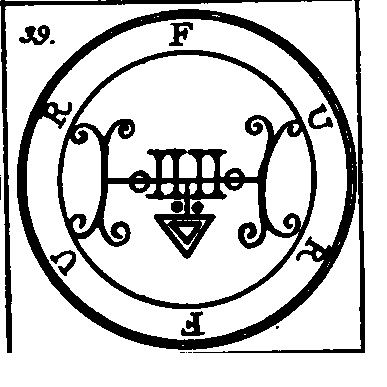
The seal of Lucifer that circulates online today comes from this milieu: it derives from the figures of the Grimorium Verum and its later versions.
Grand Grimoire: Lucifuge Rofocale
The Grand Grimoire, also sold as the Dragon Rouge, is a 19th-century French popular edition. In it Lucifer is the emperor, but the one who negotiates with the magician is his prime minister, Lucifuge Rofocale, "he who flees the light". The book became famous for its pact: the magician offers something and gains access to treasure. Owen Davies shows that these books were sold cheaply by pedlars and fed the image of the diabolical pact more than any theological treatise.
His absence from the Goetia
Many people look for Lucifer in the Goetia and do not find him. The list of 72 comes from Johann Weyer's Pseudomonarchia Daemonum, which does not include him. He only appears in passing: Belial, for example, is described as created right after Lucifer. The full explanation is in why Lucifer is not in the Goetia.
From grimoire to Luciferianism
In the grimoires, Lucifer is always the chief who is commanded in the name of God. The idea of Lucifer as liberator, teacher of consciousness and inner light comes from another source: 19th-century Romanticism, poets such as Byron and Shelley, and later orders like the Fraternitas Saturni. Contemporary Luciferianism uses the grimoires' seals but reverses the magician's role: it does not command, it allies.
- Isaiah 14: the morning star that fell.
- 15th- and 16th-century manuscripts: one of the infernal kings conjured.
- Grimorium Verum: first of the three chiefs.
- Grand Grimoire: emperor, represented by Lucifuge Rofocale.
- Goetia: absent from the list of 72.
To go further, see the guide to Luciferianism and offerings to Lucifer.
Sources and further reading
- Isaiah 14:12 (Vulgate)
- The Book of Oberon, Folger Shakespeare Library, ms. V.b.26 (16th century)
- Grimorium Verum (18th century)
- Grand Grimoire or Dragon Rouge (19th century)
- Lemegeton, Ars Goetia
- Owen Davies, Grimoires: A History of Magic Books (2009)
- Joseph H. Peterson, Grimorium Verum (2007)
Reviewed by the Chaos Society editorial team in November 2026.
Frequently asked questions
Where does the name Lucifer come from?
From the Latin for "light-bearer", the name of the morning star, the planet Venus. The Vulgate used the word to translate Isaiah 14:12, which speaks of the fall of the king of Babylon, and Christian tradition applied it to the fallen angel.
In which grimoire is Lucifer the chief of the spirits?
In the 18th-century Grimorium Verum, Lucifer is the first of the three great chiefs, alongside Beelzebub and Astaroth. In the Grand Grimoire he is the emperor, and the one who deals with the magician is his prime minister, Lucifuge Rofocale.
Is Lucifer among the 72 spirits of the Goetia?
No. The Goetia follows Johann Weyer's list, which does not include him. Lucifer is only mentioned in passing, for example in the description of Belial, created right after him.