Solomonic Goetia: traditional attribution and textual history

The Ars Goetia, part of the Lemegeton, is attributed to Solomon only by tradition; there is no historical evidence that the biblical king authored it. The Lemegeton and the Clavicula Salomonis are distinct corpora, each with its own manuscripts, editors, and translations that must be recorded separately.
Traditional Attribution versus Proven Authorship
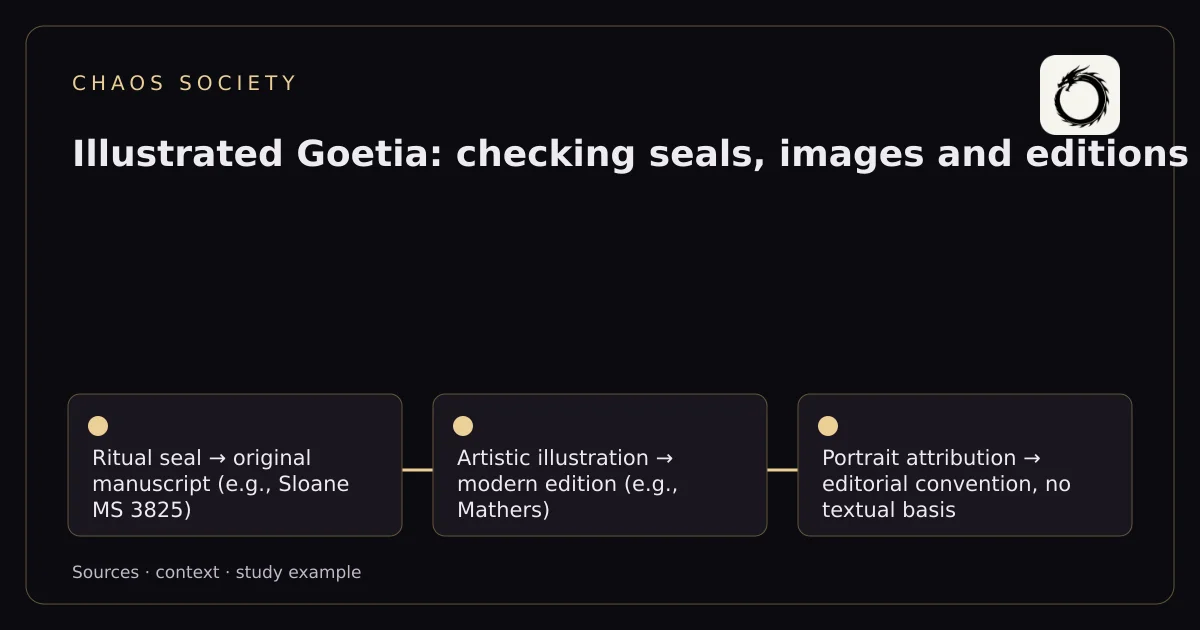
Tradition attributes Ars Goetia to Solomon, but attribution does not establish authorship by the biblical king. The consulted edition identifies manuscript witnesses, including Sloane MS 3825, and presents a catalogue of 72 spirits. Record the particular witness and editorial choices without calling one manuscript the original of the entire tradition.
Lemegeton and Clavicula Salomonis: Different Corpora
Ars Goetia is one part of the Lemegeton, not another name for the entire collection. The Clavicula Salomonis belongs to a different textual tradition. A reading record should distinguish each work and edition rather than merging all Solomonic titles into one book.
How to Record Title, Manuscript, Editor, and Translation
When creating an edition record, four fields must be clearly separated: (1) the official title of the work; (2) the manuscript or primary source (e.g., Sloane MS 3825 for the Ars Goetia); (3) the editor or translator responsible for the modern edition (e.g., S. L. MacGregor Mathers for the Clavicula); (4) the date and place of publication of the consulted edition.
These details allow tracing the textual transmission chain and prevent mixing attributes of different works.
Comparative Record: Ars Goetia × Clavicula Salomonis
- Title: Ars Goetia (Lemegeton) – Clavicula Salomonis (Key of Solomon).
- Base manuscript: Sloane MS 3825 – Various medieval manuscripts (e.g., Codex G. 2).
- Modern editor/translator: No classical editor (manuscript text) – S. L. MacGregor Mathers (1888 edition).
- Year of cited edition: 1904 (Sloane reproduction) – 1888 (Mathers).
- Practical note: Each record should indicate whether the text was translated or merely transcribed, as this changes editorial responsibility.
Frequently asked questions
Was the Ars Goetia written by Solomon?
No. The attribution to Solomon is traditional; there is no historical document proving his authorship.
Can I use the same bibliographic record for Lemegeton and Clavicula?
No. Each work has different manuscripts, editors, and translations, requiring separate records.
Are manuscript and edition equivalent?
No. Identify the witness and each editor or translator’s choices.