Philosophical Luciferianism: values, symbols and self-definition
Philosophical luciferianism is not a single doctrine; it gathers individual readings of symbols and values that may or may not include religious dimensions, varying according to the primary source consulted and each reader’s interpretation.
Absence of a Single Doctrine
The term “philosophical” indicates that luciferianism presents itself as a field of personal reflection, not as a closed set of precepts. There is no manifesto or creed that brings together all groups that call themselves luciferian, so each current can adopt or reject religious elements according to its own logic.
This plurality prevents an automatic equivalence between philosophical luciferianism and other satanic or theistic currents. Each group or individual can choose which symbols to consider relevant and how to assign them meaning.
Primary Source versus Reader Interpretation
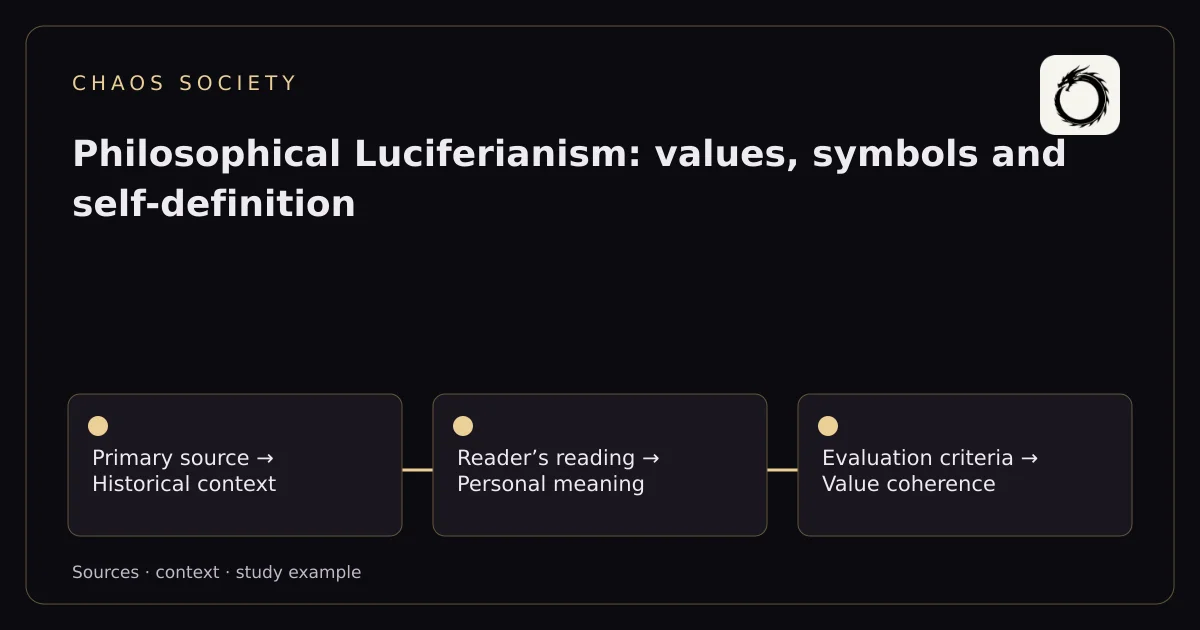
When analyzing a classical text – for example, the passage of Isaiah in the New Vulgate – the reader must distinguish the historical-textual context from the later symbolic application. The fact that Isaiah was not written as a luciferian doctrine shows that the figure of Lucifer can be used as a symbol without implying a single theological reading.
Interpretation depends on the reader’s repertoire: someone seeking a value of rebellion may emphasize the “morning star” as a metaphor of illumination; someone looking for an ethical sense may focus on the idea of questioning authority. The original text remains the same, but the meaning varies.
Practical Criteria for Analyzing Luciferian Symbols
To avoid arbitrary readings, it is recommended to apply verifiable criteria: (i) identify the historical origin of the symbol; (ii) observe whether the original author assigns it a moral or metaphysical sense; (iii) compare the personal reading with other interpretations recognized in philosophical literature; (iv) verify whether the symbol’s application serves a coherent goal within the reader’s value system.
These steps help separate aesthetic appreciation from building a set of values that can be considered luciferian in the philosophical sense.
How to Evaluate a Luciferian Symbol
- Locate the first appearance of the symbol in ancient texts (e.g., mythology or biblical literature).
- Note the sense assigned by the original author (e.g., “morning star” as a sign of hope).
- Gather contemporary interpretations in philosophical works that call themselves luciferian.
- Define which aspect (rebellion, illumination, autonomy) resonates with your own life project.
- Confirm that the choice of the symbol consistently supports your ethical and existential values.
Frequently asked questions
Does philosophical luciferianism deny any religious dimension?
No. It can include or exclude religious elements according to the individual’s choice; the designation “philosophical” only indicates that the emphasis is on personal reflection, not on the automatic exclusion of beliefs.
Is it correct to use Isaiah as a basis for all luciferian interpretations?
No. Isaiah, in the New Vulgate, provides a historical context that does not constitute luciferian doctrine; its use as a symbol depends on the reader’s interpretation of the text.
How to distinguish a luciferian symbol from a satanic symbol?
The distinction lies in the declared intention: luciferian symbols are used to express values such as autonomy or illumination, while satanic symbols are usually linked to specific satanic practices or beliefs.