How to make a grimoire: structure and a first entry
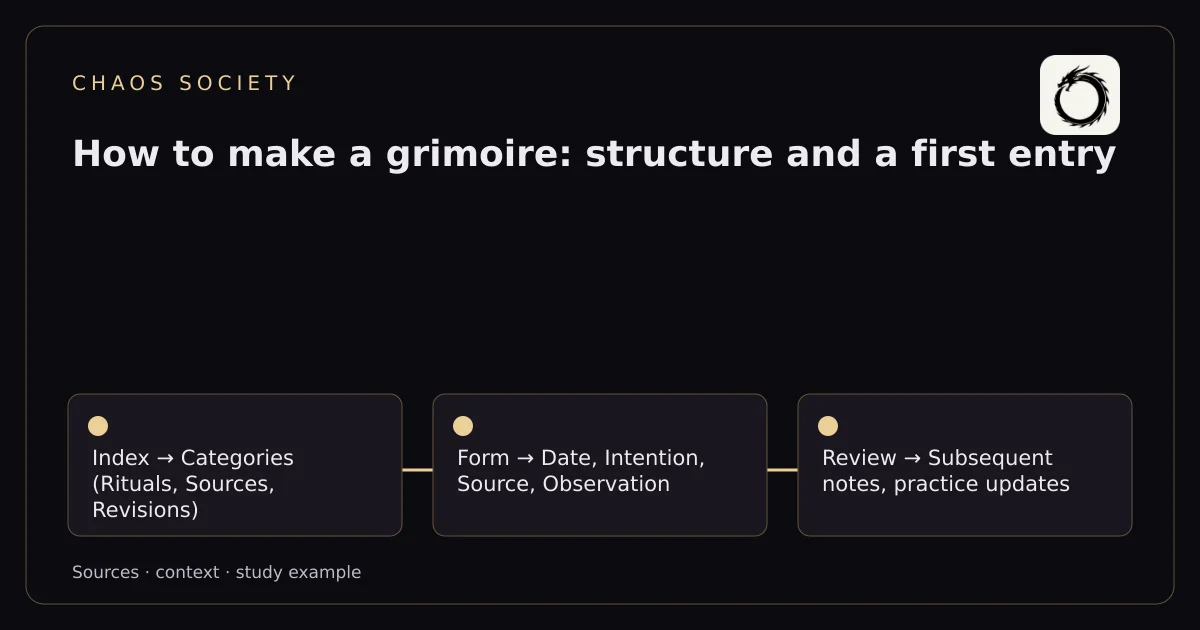
A grimoire can be created as a personal notebook, physical or digital, organized by index, sources, correspondences, practices, and revisions; the first entry should contain date, intention, source of information, and observation, without claiming to be a historical manuscript.
1. Define the form and overall organization
Choose the medium – paper notebook or digital file – and decide on a numbering scheme or markers that allow quick location of each entry. Create an initial index listing categories such as “Rituals,” “Correspondences,” “Sources,” and “Revisions.”
The structure should reflect personal practice; do not confuse it with the editing of ancient manuscripts, such as that of S. L. MacGregor Mathers, which presents title, attribution, manuscript, and edition as distinct pieces of information.
2. Record the sources and correspondences
For each piece of information noted, indicate the origin – book, oral tradition, letter, or personal experience – and, if applicable, the date of consultation. This practice prevents mixing historical material with personal notes.
The Modern Wicca Shadow Book, developed by Gardner and Doreen Valiente, illustrates how a personal notebook can evolve, but it does not automatically become an initiatory document of a lineage.
3. First entry: standard form
When starting the grimoire, use a simple form that contains four fields: date, intention, source, and observation. This model ensures consistency and facilitates later revisions.
Reserve space at the end of each entry for review notes, allowing the content to be updated as practice evolves.
Example of first entry form
- Step 1 – Record the full date (e.g., 25/10/2026).
- Step 2 – Describe the intention of the practice or research (e.g., “Invoke protection for the home”).
- Step 3 – Cite the source (e.g., “The Key of Solomon, edition by S. L. MacGregor Mathers”).
- Step 4 – Record personal observation or immediate result (e.g., “Felt distinct energy when lighting the candle”).
- Step 5 – Leave a field for future review (e.g., “Reevaluate effectiveness after 1 month”).
Frequently asked questions
Can I use an existing notebook as a grimoire?
Yes, provided you reorganize the content with an index, sources, and standardized forms, distinguishing old material from new notes.
Is it necessary to follow a historical format for the grimoire to be valid?
No; validity comes from internal coherence and clarity of sources, not from reproducing historical manuscripts.
Does digitizing the grimoire change its character?
Digitization preserves the content, but both physical and digital media are accepted, as long as the record structure is maintained.