Three-card tarot spread: positions and a worked example
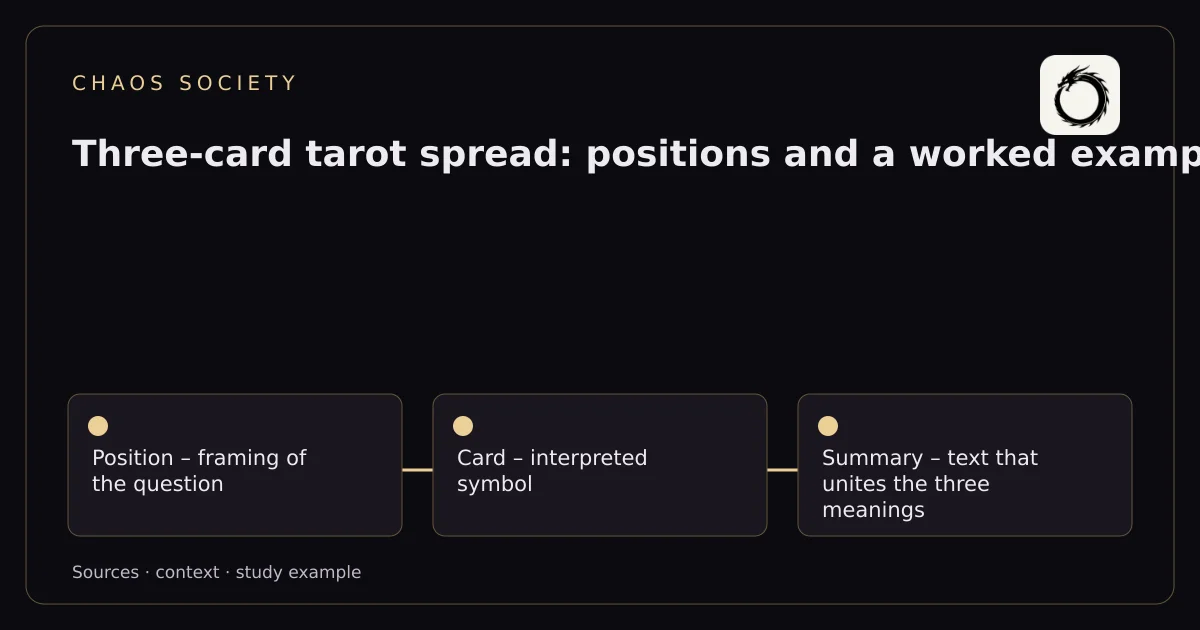
In the three-card spread, the three positions – current situation, future possibility, and next step – are defined before the cards are chosen, and each card is interpreted within its function, without claiming a universal model.
Defining the Positions Before the Spread
Define three positions before drawing: current situation, possibility to consider and next step. This is an editorial example, not a reproduction of a particular Waite spread. The Pictorial Key to the Tarot helps study imagery and interpretations in the Waite–Smith system. Keep the position’s role distinct from the card’s interpretation.
Separating Card Meaning from Position Meaning
When revealing each card, the reader should first recall the framing of the position (situation, possibility, or next step) and only then apply the traditional meaning of the card – according to the Waite-Smith system – to the defined context. For example, a card that normally indicates change will be read as “present change” if it appears in the first position, or as “option for change” if it appears in the second.
This distinction prevents the symbolism of the card from being confused with the function assigned to it, keeping the reading coherent and avoiding generic interpretations that aim to predict concrete events.
Recording the Reading Summary
After analyzing the three cards, the reader composes a short summary that brings together the three meanings: it describes the current situation, indicates the range of possibilities, and recommends a next step. This summary should be noted objectively, without including medical, financial, or legal advice, because tarot practice does not replace professional assessment.
The final note serves as a reference for the querent and allows them to reflect on the reading without relying on later interpretations that might change the original meaning.
Editorial Example of a Three-Card Reading
- Define the positions: (a) current situation; (b) future possibility; (c) recommended next step.
- Shuffle the deck and cut, maintaining the intention of the three questions.
- Lay the cards from left to right, corresponding to (a), (b) and (c).
- Identify each card and consult its traditional meaning from the Waite-Smith system.
- Draft the summary: summarize the situation, point out the possibility, and suggest the action, recording everything in writing.
Frequently asked questions
Can I use a different number of cards for the same structure?
Yes, but the three-position structure described here depends on three predefined questions; changing the number of cards requires redefining the corresponding positions.
Are the meanings of the cards the same in all readings?
The basic symbols of the Waite-Smith deck are constant, but the meaning assigned varies according to the position (situation, possibility, or step).
Is it necessary to follow Waite’s method exactly?
No; Waite’s method provides the symbol repertoire, but the choice of positions and the way of summarizing are decisions of the reader and the querent.