Moon phases in 2026: reading the calendar and checking October
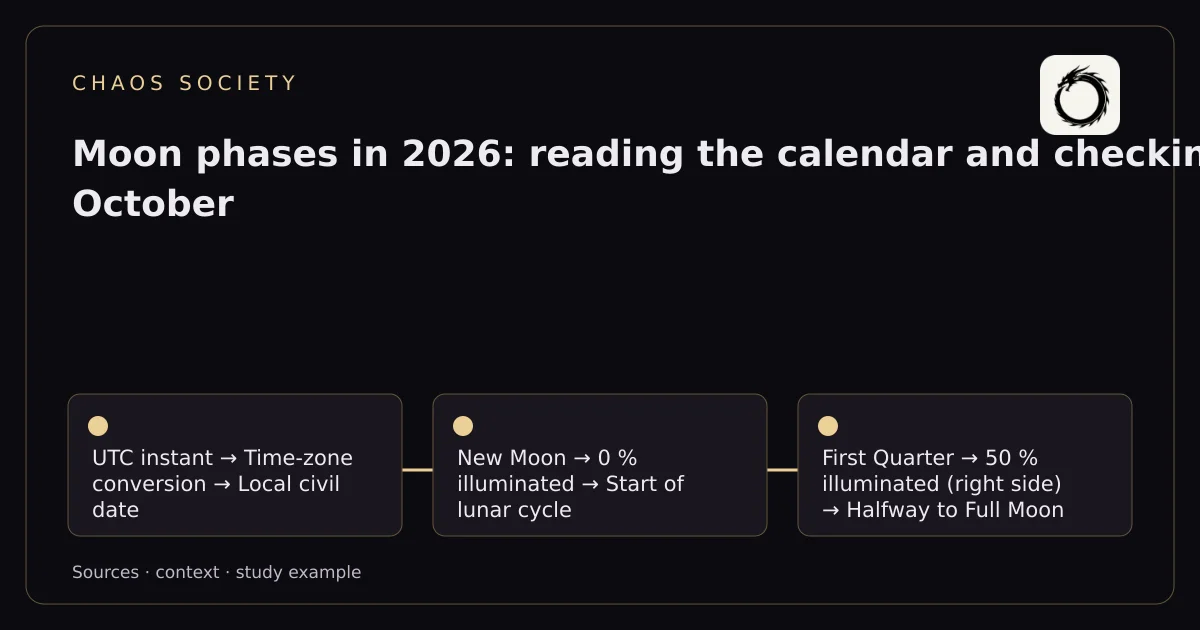
To use the 2026 lunar calendar, note that the four main phases are exact moments of illumination; the civil day on which they appear depends on the adopted time zone. Thus, correct reading combines the astronomical instant with the local date.
Instants versus civil days
The lunar phases – New Moon, First Quarter, Full Moon, and Last Quarter – are defined by precise instants when the Sun-Earth-Moon geometry reaches specific positions. These moments are recorded in Coordinated Universal Time (UTC).
When the instant occurs, each region of the planet translates it into the corresponding civil date for its time zone. Therefore, the same phase can appear on two different days in opposite time zones, such as the start of the Full Moon at 02:00 UTC being 22:00 of the previous day in UTC-4.
The four main moments
The four main phases mark reference points in the cycle. Waxing and waning describe increasing and decreasing illumination. At quarters, about half the visible disc is lit; its apparent right, left or tilted orientation depends on the observer’s location and orientation. Do not use that appearance as a universal visual rule.
Applying to October 2026
To check the lunar phase for October, locate in the table the UTC instant of each phase that falls between 1 and 31 October. Then, convert each instant to the time zone of your region (e.g., UTC-3 for Brasília). The resulting civil day will be the one that appears in the local lunar calendar.
If the instant occurs near local midnight, check whether the date changed before or after conversion; this avoids confusion such as assigning the Full Moon to the 15th when, in the chosen time zone, it occurred at 23:30 on the 14th.
Step-by-step to read the October lunar calendar
- Consult the 2026 lunar phases table and note the UTC instants of New, First Quarter, Full, and Last Quarter that fall in October.
- Determine the time zone of your location (e.g., UTC-3).
- Convert each UTC instant to local time, adjusting days when the conversion crosses midnight.
- Record the resulting civil date next to the corresponding phase; this will be the date that appears in your lunar calendar.
- Use the sequence of the four phases to estimate the intermediate phases (waxing or waning) throughout the month.
Major phases in 2026
Calculated with Astronomy Engine, shown in UTC and America/Recife (UTC−3). October and the other months are included. These are astronomical instants, not predictions of ritual effects.
| Phase | UTC | America/Recife |
|---|---|---|
| Full Moon | Jan 3, 2026, 10:03 AM | Jan 3, 2026, 7:03 AM |
| Last Quarter | Jan 10, 2026, 3:49 PM | Jan 10, 2026, 12:49 PM |
| New Moon | Jan 18, 2026, 7:52 PM | Jan 18, 2026, 4:52 PM |
| First Quarter | Jan 26, 2026, 4:47 AM | Jan 26, 2026, 1:47 AM |
| Full Moon | Feb 1, 2026, 10:09 PM | Feb 1, 2026, 7:09 PM |
| Last Quarter | Feb 9, 2026, 12:43 PM | Feb 9, 2026, 9:43 AM |
| New Moon | Feb 17, 2026, 12:01 PM | Feb 17, 2026, 9:01 AM |
| First Quarter | Feb 24, 2026, 12:28 PM | Feb 24, 2026, 9:28 AM |
| Full Moon | Mar 3, 2026, 11:38 AM | Mar 3, 2026, 8:38 AM |
| Last Quarter | Mar 11, 2026, 9:39 AM | Mar 11, 2026, 6:39 AM |
| New Moon | Mar 19, 2026, 1:24 AM | Mar 18, 2026, 10:24 PM |
| First Quarter | Mar 25, 2026, 7:18 PM | Mar 25, 2026, 4:18 PM |
| Full Moon | Apr 2, 2026, 2:12 AM | Apr 1, 2026, 11:12 PM |
| Last Quarter | Apr 10, 2026, 4:52 AM | Apr 10, 2026, 1:52 AM |
| New Moon | Apr 17, 2026, 11:52 AM | Apr 17, 2026, 8:52 AM |
| First Quarter | Apr 24, 2026, 2:32 AM | Apr 23, 2026, 11:32 PM |
| Full Moon | May 1, 2026, 5:23 PM | May 1, 2026, 2:23 PM |
| Last Quarter | May 9, 2026, 9:11 PM | May 9, 2026, 6:11 PM |
| New Moon | May 16, 2026, 8:01 PM | May 16, 2026, 5:01 PM |
| First Quarter | May 23, 2026, 11:11 AM | May 23, 2026, 8:11 AM |
| Full Moon | May 31, 2026, 8:45 AM | May 31, 2026, 5:45 AM |
| Last Quarter | Jun 8, 2026, 10:00 AM | Jun 8, 2026, 7:00 AM |
| New Moon | Jun 15, 2026, 2:54 AM | Jun 14, 2026, 11:54 PM |
| First Quarter | Jun 21, 2026, 9:55 PM | Jun 21, 2026, 6:55 PM |
| Full Moon | Jun 29, 2026, 11:57 PM | Jun 29, 2026, 8:57 PM |
| Last Quarter | Jul 7, 2026, 7:29 PM | Jul 7, 2026, 4:29 PM |
| New Moon | Jul 14, 2026, 9:44 AM | Jul 14, 2026, 6:44 AM |
| First Quarter | Jul 21, 2026, 11:06 AM | Jul 21, 2026, 8:06 AM |
| Full Moon | Jul 29, 2026, 2:36 PM | Jul 29, 2026, 11:36 AM |
| Last Quarter | Aug 6, 2026, 2:21 AM | Aug 5, 2026, 11:21 PM |
| New Moon | Aug 12, 2026, 5:37 PM | Aug 12, 2026, 2:37 PM |
| First Quarter | Aug 20, 2026, 2:46 AM | Aug 19, 2026, 11:46 PM |
| Full Moon | Aug 28, 2026, 4:19 AM | Aug 28, 2026, 1:19 AM |
| Last Quarter | Sep 4, 2026, 7:51 AM | Sep 4, 2026, 4:51 AM |
| New Moon | Sep 11, 2026, 3:27 AM | Sep 11, 2026, 12:27 AM |
| First Quarter | Sep 18, 2026, 8:44 PM | Sep 18, 2026, 5:44 PM |
| Full Moon | Sep 26, 2026, 4:49 PM | Sep 26, 2026, 1:49 PM |
| Last Quarter | Oct 3, 2026, 1:25 PM | Oct 3, 2026, 10:25 AM |
| New Moon | Oct 10, 2026, 3:50 PM | Oct 10, 2026, 12:50 PM |
| First Quarter | Oct 18, 2026, 4:13 PM | Oct 18, 2026, 1:13 PM |
| Full Moon | Oct 26, 2026, 4:12 AM | Oct 26, 2026, 1:12 AM |
| Last Quarter | Nov 1, 2026, 8:28 PM | Nov 1, 2026, 5:28 PM |
| New Moon | Nov 9, 2026, 7:02 AM | Nov 9, 2026, 4:02 AM |
| First Quarter | Nov 17, 2026, 11:48 AM | Nov 17, 2026, 8:48 AM |
| Full Moon | Nov 24, 2026, 2:54 PM | Nov 24, 2026, 11:54 AM |
| Last Quarter | Dec 1, 2026, 6:09 AM | Dec 1, 2026, 3:09 AM |
| New Moon | Dec 9, 2026, 12:52 AM | Dec 8, 2026, 9:52 PM |
| First Quarter | Dec 17, 2026, 5:43 AM | Dec 17, 2026, 2:43 AM |
| Full Moon | Dec 24, 2026, 1:28 AM | Dec 23, 2026, 10:28 PM |
| Last Quarter | Dec 30, 2026, 7:00 PM | Dec 30, 2026, 4:00 PM |
Frequently asked questions
Why can the Full Moon appear on two different days in different time zones?
Because the Full Moon is a fixed instant in UTC; when converting to time zones that are 12 hours ahead or behind, the local time can fall before or after midnight, changing the civil date.
What is the difference between waxing and waning phases?
Waxing indicates that the illuminated portion of the Moon is increasing, occurring between New Moon and Full Moon; waning indicates that the illuminated portion is decreasing, occurring between Full Moon and New Moon.
Is it necessary to use software to convert UTC to my time zone?
Not necessarily; simply add or subtract the hour difference of your time zone from the UTC instant. Online tools facilitate the calculation, but the operation is simple to do manually.