Lenormand vs tarot: cards, spreads and reading methods
Petit Lenormand commonly uses 36 cards, while the standard tarot pack has 78. The difference concerns structure and reading conventions, not a measurable hierarchy of accuracy. Identify the actual deck and its instructions before borrowing meanings from another system.
Compare the structure
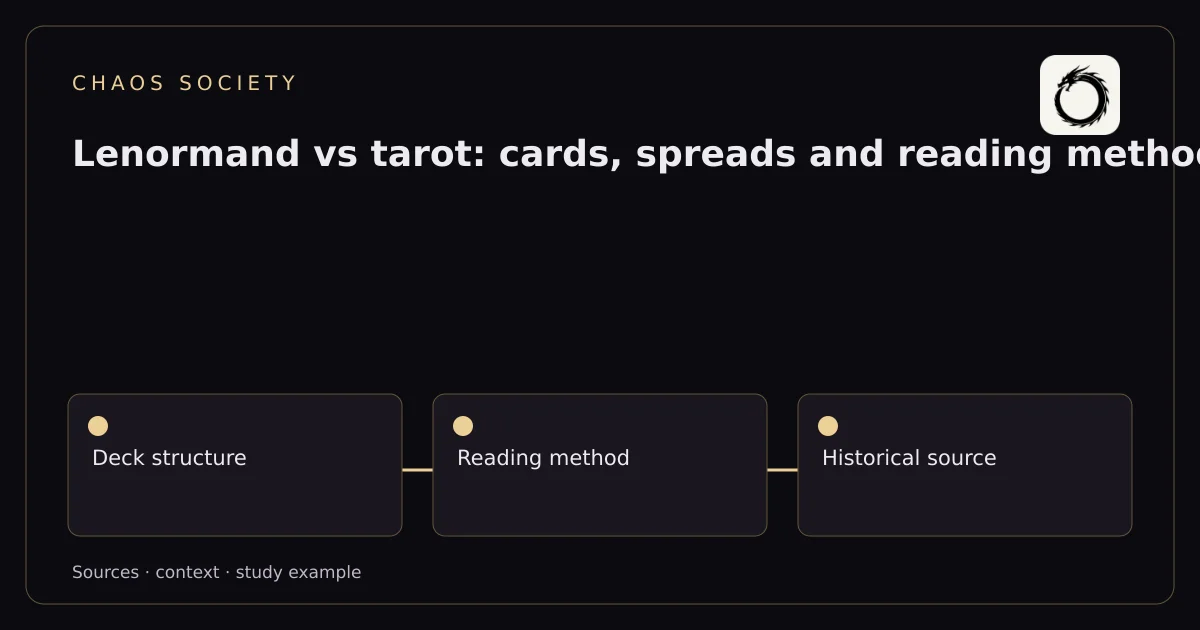
Tarot commonly divides its 78 cards into 22 major and 56 minor arcana. Petit Lenormand has a 36-card set with recognisable motifs such as Rider and Letter. Artistic detail varies between editions; Lenormand cards do not need monochrome backgrounds, and tarot decks do not all resemble Waite–Smith.
Compare an actual method
Lenormand methods often connect neighbouring images into combinations. Tarot spreads may assign functions to positions, but both traditions contain diverse approaches. A three-card example cannot define everything readers do. Record the particular convention rather than saying one system can only answer simple questions.
Check historical attribution
The British Museum’s 36-card catalogue record helps investigate the history associated with Petit Lenormand. The name alone is not evidence that Marie Anne Lenormand designed a particular pack. Waite’s Pictorial Key belongs to a different deck context, with artwork by Pamela Colman Smith.
A comparison sheet
- Pack: record publisher, edition and number of cards.
- Structure: identify suits, major cards or individual motifs.
- Method: note how positions and combinations operate.
- Source: separate documented attribution from a name used in marketing.
Frequently asked questions
Are they the same deck?
No. Standard tarot and Petit Lenormand have different structures.
Is Lenormand always visually simpler?
Its motifs are recognisable, but artistic complexity depends on the edition.
Is one proven more accurate?
The cited historical sources do not demonstrate a predictive accuracy ranking.