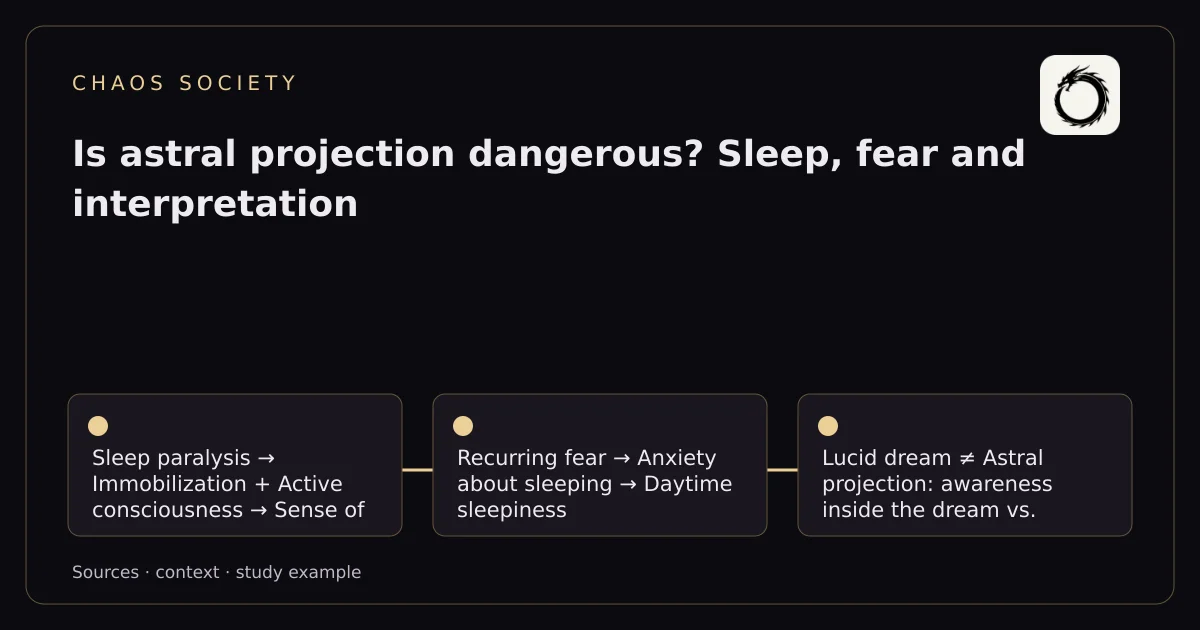
Is astral projection dangerous? Sleep, fear and interpretation
When researching astral projection, distinguish spiritual interpretation, reported sensation and sleep care. Fear and disrupted rest deserve practical attention. The cited sleep sources do not establish dangers involving a supposed spiritual cord, nor do they guarantee that every practice is risk-free.
Sleep paralysis and the sense of presence
Sleep paralysis occurs when falling asleep or waking up, when the body remains still while consciousness is active. During this state, a person may feel a presence around them, but science does not associate this sensation with external entities.
These experiences are reported by those who practice astral projection, but they can be explained as neurological phenomena. There is no need to interpret the sensation as proof of literal displacement of consciousness.
Fear and impact on rest
The fear generated by episodes of paralysis or intense interpretations can lead to anxiety about sleep. When the discomfort becomes frequent, a person may develop an aversion to sleeping or experience daytime sleepiness.
In these situations, the recommendation is to maintain regular sleep habits and seek professional evaluation, as the discomfort can be treated without resorting to techniques that alter the sleep pattern.
Distinction between lucid dreaming and astral projection
Studies on lucid dreaming, such as the International Lucid Dream Induction Study (2020), show that the awareness of dreaming occurs within the dream itself. This state does not prove literal bodily exit.
Therefore, astral projection practice should not be confused with the ability to travel outside the body; both are subjective experiences that can be studied separately.
Steps to assess the safety of the practice
- Observe whether sleep paralysis occurs when falling asleep or waking up.
- Record the frequency and intensity of the associated fear.
- Maintain a regular sleep schedule and avoid sleep deprivation.
- If episodes are recurrent and impair rest, seek guidance from a health professional.
Frequently asked questions
Does the sensation prove consciousness outside the body?
No. Sensation and independent verification differ.
Is it normal to feel a presence during sleep paralysis?
Yes, the sense of presence is a common report in sleep paralysis and does not indicate the presence of external entities.
When should I seek professional help?
If sleep paralysis or the fear associated with the practice interferes with regular sleep, causes daytime sleepiness, or significant anxiety, evaluation by a sleep specialist is recommended.