How to calculate planetary hours: day, night and time zone
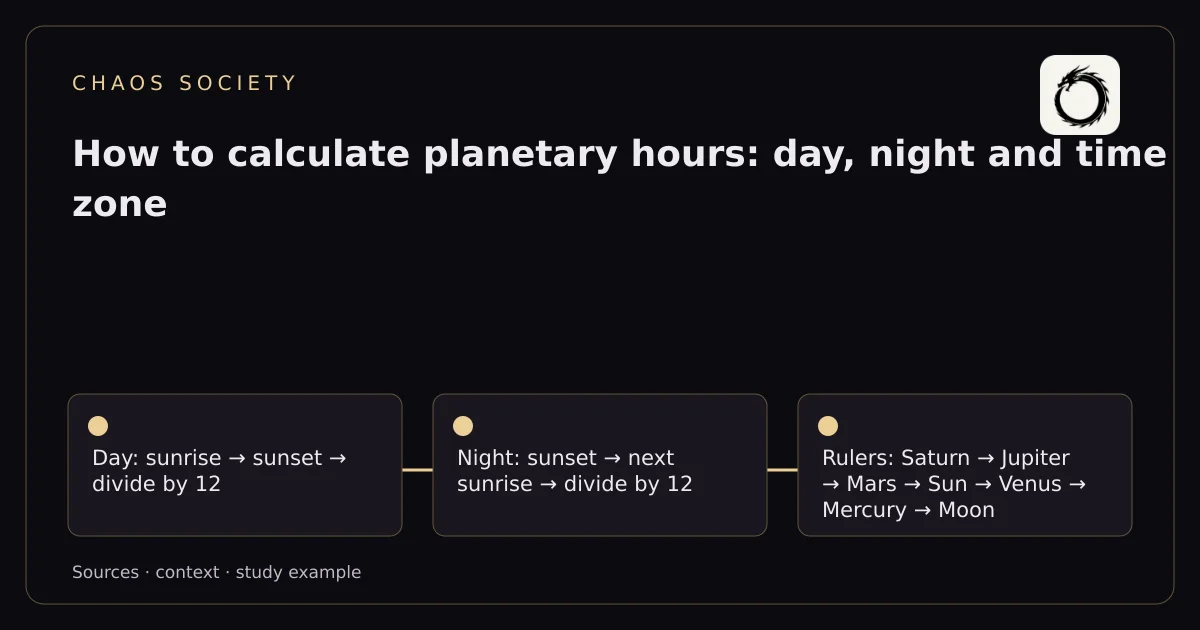
Planetary hours divide the period between sunrise and sunset into 12 equal parts and the interval between sunset and the next sunrise into another 12, assigning each segment one of the seven planets in a fixed order; the calculation depends on latitude and time zone.
Division of Day and Night
Use date, latitude, longitude and time zone to obtain sunrise and sunset. Divide daylight into 12 parts and sunset to the next sunrise into another 12. With sunrise at 06:00 and sunset at 18:00, daytime parts last 60 minutes. With sunset at 20:00 and the next sunrise at 06:00, the ten-hour night has 50-minute parts.
Sequence of Planetary Rulers
The traditional cycle is Saturn, Jupiter, Mars, Sun, Venus, Mercury and Moon. The first daytime hour takes the weekday’s ruler, and the cycle continues through the night. On Monday, for example, Moon is followed by Saturn and Jupiter. Agrippa’s Book II, chapter 22 planetary tables are a separate historical reference, not a demonstrated source here for this entire algorithm.
Influence of Latitude and Time Zone
At polar latitudes a date may lack sunrise or sunset; a tool should report that limitation rather than fabricate times. Changing only the time zone alters civil labels, not the physical interval at the same location and solar date. Identify the convention where civil-time changes occur.
Step-by-Step to Calculate Planetary Hours
- Obtain sunrise, sunset and next sunrise for the location.
- Divide each interval into 12 parts.
- Assign the weekday ruler to the first daytime segment.
- Continue the seven-ruler cycle through the night.
Frequently asked questions
Which ruler starts the day?
The first daytime hour takes the weekday’s ruler.
Does changing time zone change duration?
For the same location and instants, it changes civil labels rather than the physical interval.
What if sunrise or sunset is absent?
Report that this calculation is unavailable for that location and date.