Demonolatry vs demonology: devotion, study and classification
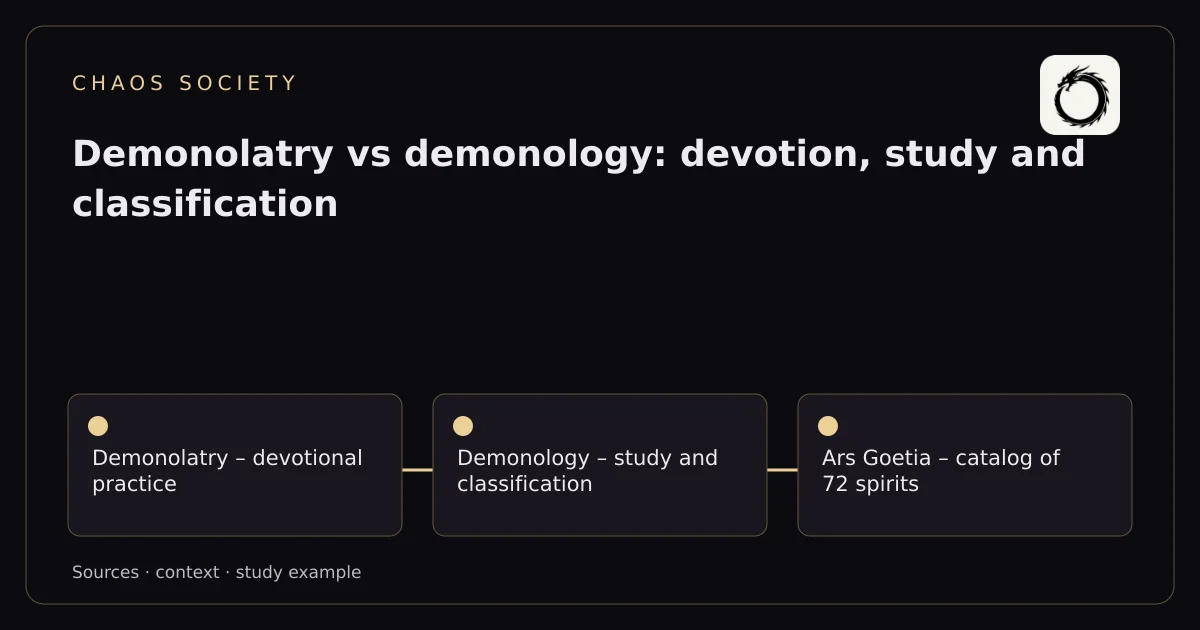
Demonolatry refers to the devotional practice toward demons in certain esoteric currents; demonology is the study and classification of these beings, such as the 72-spirit catalog of the Ars Goetia, without implying worship.
Conceptual Difference
Demonolatry describes devotional approaches identified by some practitioners. Demonology concerns study, discourse and classification of demons in religious or historical contexts. It does not necessarily imply worship, but should not be declared never related to ritual practice: identify the document and context.
Sources of Study
One of the most cited texts in demonology is the Ars Goetia, part of the Lemegeton, which lists 72 spirits. The attribution to Solomon is traditional, but there is no evidence of authorship by the biblical king.
The Clavicula Salomonis is another distinct work; it should not be confused with the Lemegeton, although both appear in contexts of Western magic.
Practices Claimed by Adherents
Sites such as Demonolatry.org provide resources for those who identify as demonolatry, but these descriptions are self-declared and do not constitute a universal standard for all currents that study demons.
The presence of specific rituals, such as those described in the Goetia, varies among groups; some use them as part of devotional practice, while others treat them only as study material.
Criteria to Distinguish Demonolatry from Demonology
- Objective: devotion (demonolatry) vs. analysis and classification (demonology).
- Authority source: personal accounts or online communities (demonolatry) vs. historical texts such as the Lemegeton (demonology).
- Use of rituals: ritual practice present (demonolatry) or absent, only as reference (demonology).
- Claim of direct contact with entities (demonolatry) vs. study of descriptions and hierarchies (demonology).
Frequently asked questions
Does every demon scholar practice demonolatry?
No. Academic or historical study of demons falls under demonology and does not imply devotion.
Is the Goetia a manual of worship?
The Goetia contains invocations and descriptions of 72 spirits; its use can be ritualistic, but the text itself is a catalog, not a treatise on worship.
Does demonolatry have a unique set of beliefs?
No. Beliefs vary among currents that self-identify as demonolatry; there is no unified dogma.