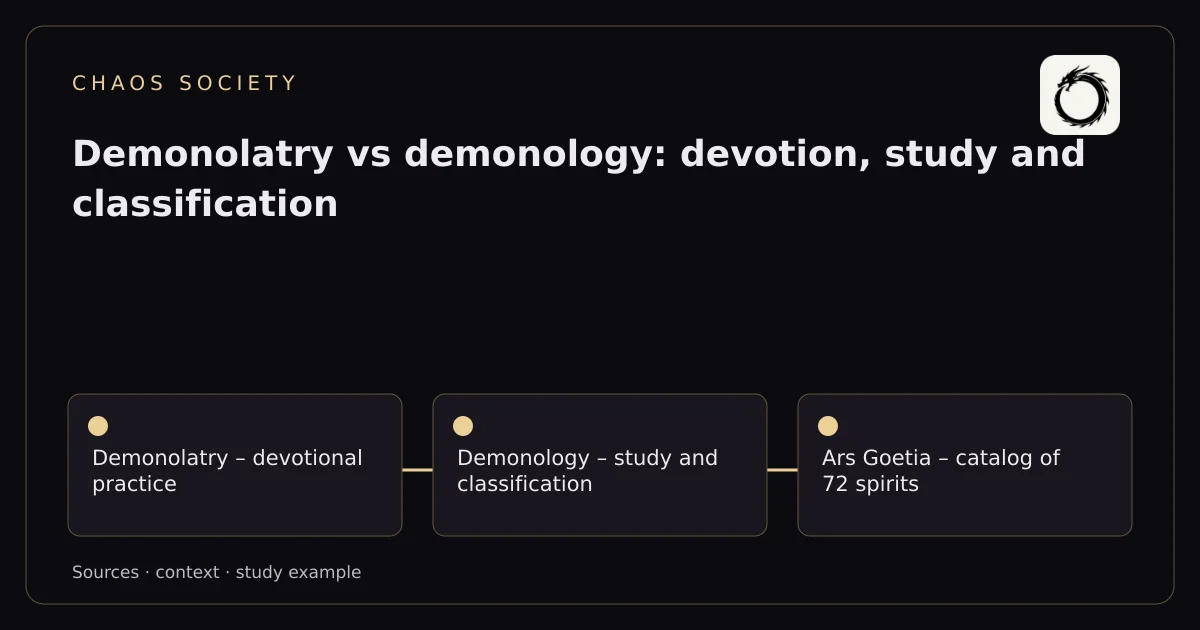
Demonolatry and Goetia: why the terms are not interchangeable

Demonolatry names devotional approaches described by some contemporary practitioners. Ars Goetia is a specific text within the Lemegeton. Comparing them requires separating a practitioner’s self-description, a historical ritual text and later adaptations that may combine elements of both.
Identify the kind of source
A contemporary demonolatry website can describe its community’s relationship with beings called demons. It is a source for that position, not a census of everyone using the term. The Esoteric Archives edition of Ars Goetia offers a different kind of document: a ritual text with a catalogue of 72 spirits.
Compare relationships and procedures
Read how a named source describes address, purpose and authority. Do not assume that every modern practitioner follows a historical text word for word, or that every use of a Goetic name implies the same devotional relationship. Identify the version and author when describing an adaptation.
Keep description separate from proof
A text documents what it says and how its editor presents it. It does not by itself demonstrate the external existence of the beings named or the effectiveness of an operation. A careful comparison can explain religious and literary differences without treating one account as the only possible practice.
Comparison grid
- Source type: devotional account or historical text.
- Relationship: how the named source describes its purpose.
- Procedure: which passage supports the comparison.
- Reception: identify later combinations and changes.
Frequently asked questions
Is demonolatry another title for Ars Goetia?
No. One describes approaches to devotion; the other is a particular text.
Do all practitioners follow one method?
The sources do not support that universal claim.
Can modern adaptations use Goetic material?
Yes, but identify the author and the changes rather than erasing the distinction.