Protective herbs: studying symbolism without promising effects
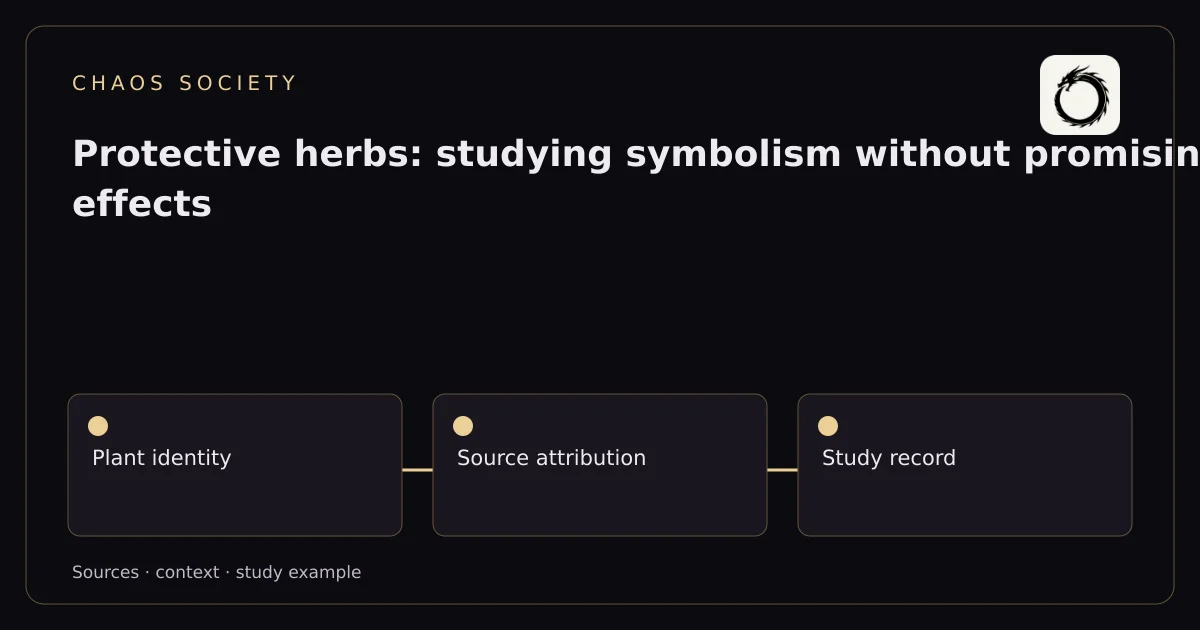
An herb described as protective carries an association in a particular symbolic system. That label is not a botanical property or evidence that the plant prevents harm. Compare an identified plant, an identified author and a clearly stated use before building your own correspondence notes.
Start with the plant
Common names can refer to different species. Record the botanical name from a reliable plant reference. Kew lists Salvia rosmarinus for rosemary, with Rosmarinus officinalis as a synonym; a regional name alone is not enough to transfer an entry to another plant.
Identify the correspondence source
Cunningham’s Encyclopedia of Magical Herbs is a modern practitioner reference for symbolic associations. Its correspondences are not a universal account of every tradition or a clinical assessment. Copy your own short reference notes, with edition and entry, rather than treating an attribution as demonstrated chemistry.
Use a non-contact study example
For a correspondence notebook, a labelled illustration is enough. Set botanical information in one column and the author’s association in another. This avoids turning a symbolic reading exercise into a recipe for burning, bathing or ingesting an unfamiliar plant.
Correspondence card
- Identification: scientific name and reference.
- Association: the named author and entry.
- Context: what the source actually claims.
- Study material: a labelled drawing or photograph.
- Limit: symbolism does not demonstrate protection.
Frequently asked questions
Does protective mean medicinal?
No. A symbolic attribution is not a medical indication.
Can common names be ambiguous?
Yes. Identify the species before comparing entries.
Must I burn an herb to study it?
No. An image and a well-referenced notebook are sufficient here.